Moe is justice! A small site that occasionally shares ACG event logs and interesting code.





Would You Like to Visit a Planetarium? Anime Pilgrimage to Akashi Municipal Planetarium from planetarian
August 14, 2025, sunny. Today I went to the Akashi Municipal Planetarium in Akashi to see the stars!
There was once a work that depicted a post-apocalyptic world.
Without grand production, relying solely on its script, even a single line left a deep impression on me when I was a student.
"Would you like to visit a planetarium? It is a beauty that never fades, an eternal brilliance... The sky full of stars is waiting for everyone."
This work is the short AVG adventure game released by Key in 2004—planetarian ~The Reverie of a Little Planet~.
And today, I went to the Akashi Municipal Planetarium in Akashi to fulfill a long-held wish—to see a sky full of stars at the location that inspired the work.
Arriving in Akashi

Due to the Kumamoto floods the day before, I didn't arrive at my hotel in Akashi until around 11 p.m.
So I missed the chance to explore Akashi.


The hotel I stayed at this time had a view of Akashi Castle from the window—a castle-view room.


The view outside the window in the morning.

Akashi Castle seen from the station. I'll definitely visit next time I have the chance!
Lunchtime
Since I was in Akashi, the most famous local specialty is Akashiyaki!
But wait, why are there long lines at every Akashiyaki shop?

Because time was tight, I switched to having grilled meat instead.
Next time I'll definitely come back to try the local Akashiyaki!
Akashi Municipal Planetarium
Actually, the scenes in the original work combined two locations.
The department store was based on Matsubishi Department Store in Hamamatsu, Shizuoka Prefecture. Unfortunately, that department store has already been demolished.
And the planetarium projector was based on the Akashi Municipal Planetarium, my destination this time.


The Akashi Municipal Planetarium is located in Akashi City, Hyogo Prefecture. It is one of Japan's most distinctive planetariums, opened in 1960 on "Time Day," situated exactly on the 135th meridian east, the baseline for Japan Standard Time. The planetarium houses Japan's oldest still-operating planetarium projector, made by Carl Zeiss Jena in Germany, renowned for its manual operation and live commentary. In addition to vivid starry sky demonstrations, it features exhibitions on time and the universe, various ancient and modern timepieces, meteorite models, a hands-on area for families, an observation deck, and an astronomical observatory with a 40cm reflecting telescope. Its iconic clock tower has become a symbol of "Akashi, the City of Time," blending science education, cultural heritage, and tourism appeal.
Please note that the planetarium will undergo renovations starting in October 2025, expected to be completed by summer 2026.
If you plan to visit soon, be sure to check the latest facility information.

The 135th meridian.
1F Entrance
On the 1st floor, you can buy tickets andget a numbered ticket for the planetarium.
Also, the planetarium is very considerate—you can store your luggage there!
Since I had researched beforehand, I chose to leave my luggage at the planetarium instead of the hotel.
3F Exhibition Hall


The exhibits range from the clocks closest to our daily lives to the vast universe.
Here you can even observe the current state of the sun.
A simple ball-drop simulation of a black hole.
4F Sundial Plaza


This area displays devices humans used to tell time by the sun.
I can't help but marvel at the ingenuity of ancient people.


From here you can see Akashi's famous bridge—the Akashi Kaikyō Bridge.
There was once a work called narcissu, where the characters drove across this bridge to Awaji Island.
This bridge is also depicted in Makoto Shinkai's famous film Suzume.
13F & 14F Observation Deck


From the observation deck, you can enjoy a 360° view of the entire city of Akashi.
2F Planetarium
You can check the planetarium's daily schedule here: https://www.am12.jp/time/
For recent planetarium show content, see: https://www.am12.jp/pla-program/


Entering the 2nd floor, there is first a lot of information about the projector.
The projector at Akashi Municipal Planetarium is an optical device manufactured by Carl Zeiss Jena in Germany, introduced in 1960. It is hailed as "Japan's oldest operating planetarium projector" and can finely reproduce about 9,000 stars, as well as the sun, moon, planets, the Milky Way, comets, and other celestial phenomena. It is still in operation today and combined with the new digital system "StellaDome Pro" introduced in 2024, creating a unique blend of optical and digital projection that allows visitors to feel both the weight of history and the stunning starry sky experience brought by modern technology.
In this modern society, projectors have been miniaturized. Seeing such a huge projector still in operation today truly conveys a sense of historical depth.

You can even see the signed original illustration for the 15th anniversary of planetarian.
Universal 23/3 projector (Jena)


Now, let's welcome Miss Jena!


Photography was allowed before and after the show, so I took pictures of Miss Jena from various angles.
Honestly, the moment I saw this machine, tears welled up in my eyes.

The nameplate of the projector.

And the record of Japan's longest-serving planetarium projector.
August 14th was Miss Jena's 23,806th day of operation.
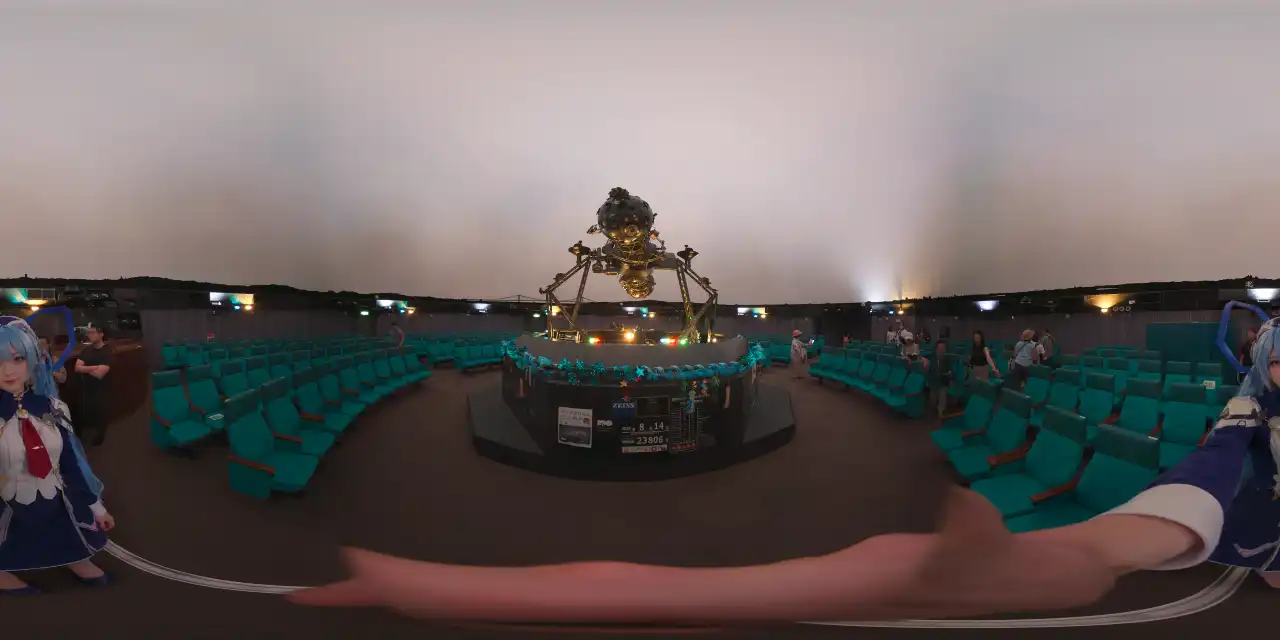
A panoramic view of the entire dome.
Beneath the white screen is the horizon of Akashi city.
Show Content
The show I watched that day was titled "Black Hole Tour."
The projection at Akashi Municipal Planetarium is accompanied by live narration, which is incredibly sincere in this age of automation!
The content started with the sunset in Akashi, showing what stars would be visible in the night sky over Akashi on August 14, 2025.
It began with the most familiar stars and constellations like the Big Dipper, Polaris, and the Summer Triangle, then gradually expanded to various constellations.
At that point, the narrator asked us to close our eyes and let them adjust to the darkness.
When we opened our eyes again, we saw the Milky Way!

I edited it with photo software, and the effect was roughly like this.
It was truly beautiful! No wonder the protagonist in the original work decided to bring the starry sky to all of humanity after seeing it.
The show continued.
Starting from the Milky Way, the journey to the black hole truly began!

Just as demonstrated in the exhibition hall, since the center of the Milky Way is a supermassive black hole, heading toward the galactic center leads to a black hole.
This segment introduced the latest black hole research findings from recent years and how we captured those donut-shaped black hole photos.
The content was quite hardcore but very interesting! Though my Japanese vocabulary wasn't quite sufficient 😂.
As the black hole journey concluded, the scene returned to Earth, to the skies above Akashi.
With the sun rising in the east, a new day began!
That was a summary of the show. There was actually a lot more content, and the projection lasted about an hour.
Limited by my descriptive ability, I can only give a rough outline. If you're interested, I highly recommend experiencing it in person—it will definitely leave you with wonderful memories!
Conclusion
With the end of the show, my trip to Akashi came to a perfect close.
Currently, the overall experience at Akashi Municipal Planetarium, including the show, takes about two hours. I wonder if there will be new content after the renovation next year!
The overall feeling was an indescribable emotion. I never thought there would be a day when I could see the same starry sky as in planetarian.
Also, Akashi has many other interesting places that I didn't get to visit due to this trip's schedule. I've decided to pick another time in the future to fully experience Akashi.